Viraj Pandya
2025 Regional Award Finalist — Post-Doc
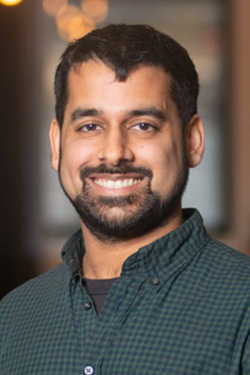
Current Position:
Postdoctoral Research Scientist
Institution:
Columbia University
Discipline:
Astrophysics & Cosmology
Current Position:
Postdoctoral Research Scientist
Institution:
Columbia University
Discipline:
Astrophysics & Cosmology
Recognized for: Groundbreaking discoveries on early galaxy evolution, reshaping our understanding of how galaxies formed and challenging longstanding theories of the early universe.
Areas of Research Interest and Expertise:
Galaxy formation in a cosmological context, thermodynamics of galactic atmospheres, intrinsic alignments of early elongated protogalaxies, massively parallel and differentiable Bayesian modeling of complex dynamical systems, spectroscopic and multi-wavelength photometric galaxy surveys
Previous Positions:
BA (Economics and Mathematics), Rutgers University
Astronomy Research Assistant, Rutgers University (Advisors: Saurabh Jha, Rachel Somerville)
Post-Baccalaureate Fellow in Astrophysics, Princeton University (Advisor: Jenny Greene)
MA, University of California Santa Cruz (Advisors: Joel Primack, Jean Brodie)
PhD, University of California Santa Cruz (Advisors: Kevin Bundy, Rachel Somerville)
NASA Hubble Postdoctoral Fellow, Columbia University (Advisor: Greg Bryan)
Research Summary:
Our universe’s evolution is a long-studied, hotly-debated subject – dark matter, dark energy, and regular matter all play important roles. Research driven by astrophysicist Viraj Pandya, PhD, shows an unexpected result about the early universe: instead of discs or spheres, most early galaxies had elongated, linear shapes aligned with larger-scale, thread-like "filaments" of dark matter that dictated their formation. Pandya’s work continues to study the co-evolution of visible and dark matter within and around galaxies using an interdisciplinary blend of theory, observations, and AI-accelerated data science, showing us how the echoes of the early universe continue to affect our galactic neighborhood.
“I am humbled and grateful to be recognized as a Blavatnik Scholar. This award gives me the confidence to continue my foundational research towards a fully predictive theory of galaxy formation—one of the grand challenges of modern astrophysics.”
Key Publications:
Other Honors:
2023 Astronomy & Astrophysics Grant (#2307419), National Science Foundation
2021 Hubble Postdoctoral Fellowship (#HST-HF2-51489), NASA
2020 Pre-Doctoral Fellowship in Computational Astrophysics, Flatiron Institute
2016 Osterbrock Leadership Fellowship, UC Santa Cruz
2016 Regents Fellowship, UC Santa Cruz
2016 Graduate Research Fellowship, National Science Foundation
2014 Post-Baccalaureate Fellowship in Astrophysics, Princeton University
In the Media:
The New York Times — The Early Universe Was Bananas
NASA — Webb Shows Many Early Galaxies Looked Like Pool Noodles, Surfboards